

Article 1 of “Liberland vs the World” series
In a world of sprawling empires and bustling nations, two tiny territories dare to dream big. Monaco, a 2-square-kilometer jewel on the French Riviera, dazzles with its tax-free haven, billionaire playground, and a passport that unlocks 170+ countries. Liberland, a 7-square-kilometer libertarian experiment founded in 2015 by Vít Jedlička on a disputed Danube River plot, bets on blockchain governance, zero taxes, and a global e-residency program. Inspired by Monaco’s elite citizenship, Liberland blends a small, merit-based physical citizenry (targeting ~3,000-10,000) with ~800,000 e-residents, yet struggles for legitimacy amid Croatia’s territorial control. How does a glamorous microstate stack up against a bold, unrecognized upstart? In this opening salvo of Liberland vs. the World, we dissect their paths to international recognition across eight pillars, uncovering lessons for Liberland’s quest to shine as a libertarian beacon.
Historical Origins: Legacy vs. Vision
Monaco’s story began in 1297 when the Grimaldi family seized the Rock, securing sovereignty through a 1861 treaty with France and UN membership in 1993. Its recognition, bolstered by ~50 bilateral treaties (UNTC data), stems from centuries of diplomacy and French protection. Liberland, declared on terra nullius between Croatia and Serbia, claims statehood under the Montevideo Convention but lacks UN recognition, relying on five MOUs (e.g., Somaliland, Haiti). Monaco’s treaty-driven path suggests Liberland could adopt symbolic treaties (e.g., Vienna Convention) to signal legitimacy, though its youth limits immediate impact.
Metric Snapshot:
• Year of Establishment: Monaco 1297 (sovereignty 1861); Liberland 2015.
• UN Membership: Monaco 1993; Liberland N/A.
• Bilateral Treaties: Monaco ~50; Liberland 5 MOUs.
Citizenship: Exclusivity vs. Scalability
Monaco’s citizenship, limited to ~9,000 of 39,000 residents, is a golden ticket. Governed by the 1992 Code of Monegasque Nationality, it requires jus sanguinis (Monegasque parent), 10 years post-marriage residency, or 10 years residency with exceptional merit (e.g., philanthropy), with no dual citizenship for naturalized citizens. Liberland’s dual model offers ~1,200 full citizens (merit-based, 5,000+ Liberland Merits via contributions) and ~700,000 e-residents (open to libertarian supporters, ~$5,000-$10,000 fee), allowing dual citizenship. Monaco’s exclusivity (4.3:1 population-to-citizen ratio) contrasts Liberland’s scalability (583:1), but Liberland could refine elite criteria to mirror Monaco’s wealth-driven appeal.
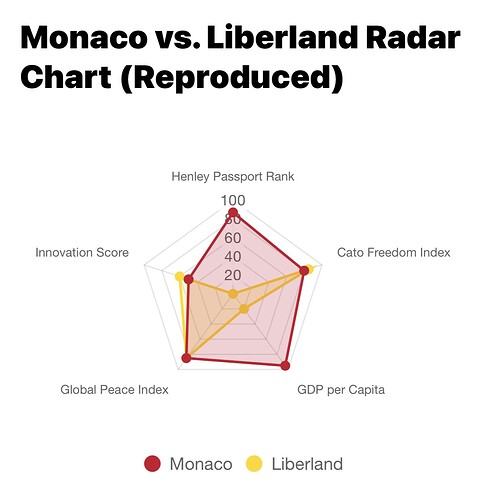
Metric Snapshot (Henley Passport Index 2025, World Bank):
• Population vs. Citizens: Monaco 39,000/9,000; Liberland 700,000/1,200.
• Passport Rank: Monaco ~5th (170+ visa-free); Liberland N/A (Somaliland MOU only).
• Dual Citizenship: Monaco No; Liberland Yes.
Governance and Economy: Monarchy vs. Blockchain
Monaco’s constitutional monarchy, led by Prince Albert II, ensures stability, with a $7 billion GDP driven by banking and tourism (World Bank, 2025). Its zero-income-tax policy attracts billionaires. Liberland’s presidential republic with blockchain voting (10% quorum) and virtual economy (e-residency fees, Liberland Merit/LLM cryptocurrency) also avoids taxes but lacks physical infrastructure. Monaco’s centralized governance contrasts Liberland’s decentralization, suggesting Liberland could adopt merit-based Congress vetting for stability.
Metric Snapshot (Cato Human Freedom Index 2023, World Bank):
• Freedom Index: Monaco ~8.0; Liberland ~8.5 (estimated).
• GDP per Capita: Monaco ~$240,000; Liberland N/A (virtual potential).
• Tax Burden: Both 0% of GDP.
Culture and Society: Tradition vs. Libertarianism
Monaco’s elite culture blends French sophistication with wealth, low diversity due to exclusivity. Liberland’s global e-residency fosters a diverse, libertarian ethos of “live and let live.” Monaco’s cultural prestige suggests Liberland could promote its values to attract like-minded communities.
Metric Snapshot (Global Peace Index 2025):
• Peacefulness: Monaco ~1.5; Liberland ~1.5 (estimated).
• UNESCO Sites: Monaco 0; Liberland 0.
Innovation and Technology: Banking vs. Blockchain
Monaco leverages banking tech for wealth management, ranking high on the IMD World Competitiveness Index (~10th, 2025). Liberland’s blockchain-based e-residency and governance lead in innovation (estimated top 50). Monaco’s tech stability suggests Liberland could scale blockchain for global appeal.
Metric Snapshot (Global Innovation Index 2024):
• Innovation Score: Monaco ~50; Liberland ~60 (estimated).
• Blockchain Adoption: Monaco low; Liberland high (Chainalysis).
Military and Neutrality: Protection vs. Principle
Monaco relies on France for defense (0% GDP expenditure, SIPRI), maintaining neutrality. Liberland’s non-aggression principle (no army) aligns with neutrality, suggesting symbolic neutrality declarations could boost legitimacy.
Metric Snapshot (Global Peace Index 2025):
• Militarisation: Both ~0.
• Neutrality Status: Monaco Yes; Liberland Symbolic.
Environment and Sustainability: Riviera vs. Danube
Monaco’s urban sustainability (Environmental Performance Index ~70) contrasts Liberland’s virtual low-impact model (estimated ~80). Liberland’s Danube location offers green potential, learning from Monaco’s eco-initiatives.
Metric Snapshot (EPI 2024):
• EPI Score: Monaco ~70; Liberland ~80 (estimated).
• Renewable Energy: Monaco 5%; Liberland 100% virtual.
Education and Human Capital: Elite vs. Virtual
Monaco’s high tertiary enrollment (~50%, UNESCO) supports its economy. Liberland’s online learning platforms for e-residents (estimated 75% Human Capital Index) suggest virtual education could drive legitimacy.
Metric Snapshot (World Bank, UNESCO):
• Human Capital Index: Monaco ~0.8; Liberland ~0.75 (estimated).
• Tertiary Enrollment: Monaco 50%; Liberland N/A (virtual high).
Infographic Chart
Lessons for Liberland
Monaco’s treaty-driven recognition and elite citizenship offer a blueprint. Liberland could:
• Adopt symbolic treaties (e.g., Vienna Convention) to signal legitimacy.
• Refine full citizenship criteria to attract high-value stakeholders, like Monaco’s wealth focus.
• Scale e-residency to mirror Monaco’s economic appeal, leveraging diaspora villages (e.g., Serbia’s Ark Village).
Join Liberland’s e-residency at liberland.org to shape a libertarian future, and follow us on X for updates!
Discover more from Liberland Press
Subscribe to get the latest posts sent to your email.

