
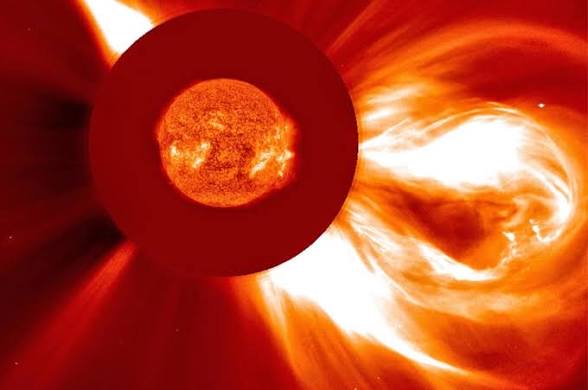
A Carrington-level solar storm — named after the 1859 event observed by astronomer Richard Carrington — represents one of the most extreme space weather phenomena possible. In that historic geomagnetic storm, auroras were visible as far south as the Caribbean, and telegraph systems sparked, caught fire, and shocked operators. Today, a similar coronal mass ejection (CME) hitting Earth could induce powerful geomagnetically induced currents (GICs) in long power lines, overheating and potentially destroying high-voltage transformers — the critical, hard-to-replace backbone of the modern electric grid.
A Carrington-scale event today could cause multi-week to multi-year blackouts across large regions, trillions in economic damage, and severe societal disruption. While rare (estimates suggest a roughly 10-12% chance per decade for something comparable), recent strong storms like the G5 event in May 2024 remind us the Sun is active, and preparedness matters.
Fortunately, people, communities, utilities, and governments can take meaningful steps to build resilience against such threats. These range from large-scale grid hardening to localized, decentralized solutions.
Understanding the Threat: How Solar Storms Impact the Grid
Solar storms release charged particles that interact with Earth’s magnetosphere, creating fluctuating magnetic fields. These induce low-frequency currents (GICs) in conductive ground and long transmission lines. The biggest vulnerability lies in extra-high-voltage transformers, which can saturate, overheat, and fail — often requiring months or years to replace due to limited manufacturing capacity.
Historical near-misses (like a 2012 CME that barely missed Earth) and smaller events (Quebec blackout in 1989) show the risk is real, though modern grids have some built-in tolerances.
Utility and National-Level Grid Hardening Strategies
The primary responsibility for protection lies with utilities and regulators, but community advocacy can push for faster adoption.
Key hardening measures include:
- GIC Blocking or Mitigation Devices — Neutral blocking capacitors, series capacitors, or neutral grounding resistors limit or divert GICs away from transformers. Some utilities have tested these successfully, though widespread deployment remains limited due to cost (estimated $10–30 billion for full U.S. grid hardening).
- Grid Operational Adjustments — With advance warning from NOAA’s Space Weather Prediction Center (typically hours to days), operators can reduce line loads, adjust voltage, or even temporarily disconnect vulnerable sections to prevent cascading failures.
- Hardened Transformer Design — New transformers are increasingly specified with higher GIC tolerance, and retrofits like shielding or monitoring sensors help detect issues early.
- Monitoring Networks — Real-time geomagnetic field sensors and wide-area monitoring systems allow proactive responses.
These national-scale efforts provide the first line of defense, but in a true Carrington event, widespread damage could still occur — making local resilience essential.
Community and Individual-Level Resilience: Decentralization as the Key
When the main grid fails, decentralized energy systems shine. Communities and households can prepare by reducing dependence on vulnerable centralized infrastructure.
1. Embrace Microgrids and Islanding Capability
Microgrids are small-scale power systems that can operate independently (“island”) from the main grid during disruptions.
- Community microgrids — Groups of homes, businesses, schools, or critical facilities (hospitals, water treatment) powered by solar panels, wind turbines, battery storage, and sometimes backup generators.
- Benefits during solar storms — They avoid long transmission lines prone to GICs and can disconnect automatically when threats are detected.
- Real-world examples — After Hurricane Maria in Puerto Rico, many communities adopted solar-plus-storage microgrids for reliable power during grid outages. Similar approaches work for space weather resilience.
Here are examples of resilient community microgrid setups:
These visuals show solar-powered microgrids with battery storage — ideal for maintaining essential power when the main grid is compromised.
2. Household-Level Preparations
Individuals can build personal resilience:
- Solar panels with battery backup — Off-grid or hybrid systems (e.g., with Tesla Powerwall or similar) provide power independence. Direct solar panels are minimally affected by geomagnetic storms (unlike grid-tied inverters without protection).
- Surge protection — Whole-house surge suppressors at the electrical panel offer basic defense against induced voltage spikes (though insufficient alone for extreme events).
- Backup power — Portable generators, solar generators, or even manual disconnection from the grid during warnings.
- Preparedness kit — Stock non-perishable food, water, medical supplies, radios, and alternative lighting/charging for weeks without grid power.
The Path Forward: Collective Action for Resilience
A Carrington-level event is low-probability but high-impact. Building true resilience requires a multi-layered approach:
- Advocate for utility investment in GIC protection and better forecasting.
- Support community microgrid projects and local renewable energy initiatives.
- Prepare personally with backup power and emergency plans.
With improving space weather forecasts, hardening technologies, and decentralized energy, we can dramatically reduce the fallout from the next major solar storm. The key is acting now — before the lights go out.
Discover more from Liberland Press
Subscribe to get the latest posts sent to your email.

