Home Blog Page 2

Protocol I Additional to the Geneva Conventions (1977)

0

Introduction

Protocol I Additional to the Geneva Conventions of 12 August 1949, and relating to the Protection of Victims of International Armed Conflicts, was adopted on 8 June 1977 by the Diplomatic Conference on the Reaffirmation and Development of International Humanitarian Law Applicable in Armed Conflicts. It expands and updates the four Geneva Conventions, particularly in areas such as the protection of civilians, methods and means of warfare, and the treatment of combatants in international armed conflicts. The protocol introduces concepts like the principle of distinction, proportionality, and precautions in attack, while also addressing issues such as indiscriminate attacks and the protection of cultural objects.

For a small, peaceful entity such as Liberland, with no armed forces, no involvement in international armed conflicts, and no territory subject to occupation or hostilities, Protocol I is of very low practical relevance. Its provisions apply exclusively to situations of international armed conflict and impose obligations on states engaged in or potentially subject to such conflicts. As of January 2026, Protocol I has 174 states parties (ICRC data). Neutral assessment indicates that while the protocol contributes to the development of international humanitarian law and reinforces protections for individuals in wartime, it is not a priority for ratification or engagement at this stage of Liberland’s development. Any affiliation would be largely symbolic, with minimal direct benefits or burdens.

Summary

Protocol I was negotiated from 1974 to 1977 at the Diplomatic Conference in Geneva, building on the four 1949 Geneva Conventions to address gaps exposed by post-World War II conflicts, particularly decolonization wars and modern warfare technologies. It entered into force on 7 December 1978 after two ratifications. The protocol applies to international armed conflicts (Article 1), including wars of national liberation (Article 1(4)—a controversial provision opposed by many Western states).

Key provisions include:

  • Protection of civilians and civilian objects (Articles 48–60): principle of distinction, proportionality, precautions in attack
  • Prohibition of indiscriminate attacks (Article 51)
  • Protection of cultural objects and places of worship (Article 53)
  • Rules on means and methods of warfare (Articles 35–42), including prohibition of weapons causing superfluous injury or unnecessary suffering
  • Protections for medical personnel, units, and transports (Articles 8–31)
  • Status of combatants and prisoner-of-war rights (Articles 43–47)

As of January 2026, 174 states are parties. The United States signed but has not ratified (due to concerns over Article 1(4) and other provisions). In 2025, the protocol continued to influence ICRC legal interpretations and international jurisprudence, including ICJ and ICC proceedings related to conflicts in Ukraine and Gaza. The ICRC’s updated commentaries (ongoing since 2016) incorporate modern applications, such as cyber operations and autonomous weapons. For a libertarian perspective, Protocol I’s restraints on state violence in war support non-aggression, but its detailed regulatory framework and state-centric obligations introduce elements of mandatory action.

Inner Content

Individual Liberty (7/10)
Protocol I scores a 7 in individual liberty by strengthening protections for civilians and combatants in international armed conflicts, limiting arbitrary harm and ensuring humane treatment. Articles 51–60 prohibit indiscriminate attacks and require proportionality, reducing risks to personal safety and property. Protections for medical personnel (Article 8) and cultural objects (Article 53) preserve spaces for life and heritage.

The score is moderated because the protocol applies only in international armed conflicts and imposes obligations on states that could limit military flexibility. For Liberland, with no armed forces or conflict exposure, it offers neutral humanitarian alignment without direct impact on daily freedoms.

Minimal Government (5/10)
The protocol earns a 5 in minimal government due to its detailed rules on conduct of hostilities (Articles 48–60) and requirements for dissemination and training (Article 83), which can expand military and administrative roles in IHL compliance. While it does not create a supranational enforcement body, implementation often involves national legislation and military doctrine updates.

Free Markets (5/10)
A 5 in free markets, as protections for civilian objects and infrastructure (Articles 52–56) reduce war’s economic disruption, but the treaty has no direct market provisions.

Non-Aggression (8/10)
An 8 in non-aggression, as the protocol prohibits unnecessary suffering (Article 35), indiscriminate attacks (Article 51), and attacks on civilians (Article 51), promoting restraint in warfare.

Decentralization (6/10)
The 6 in decentralization reflects national responsibility for implementation, but the protocol’s universal standards introduce uniformity.

Feasibility (7/10)
A 7 in feasibility, with 174 parties and straightforward ratification for peaceful states.

Citizen Consent (6/10)
A 6 in citizen consent, as state ratification implies democratic agreement, but military-focused obligations may not fully reflect individual preferences.

Cost (1–10)
Cost: 8

  • Ratification: Low ($500–$2,000 for deposit with the Swiss Federal Council and legal review).
  • Compliance: Low ($2,000–$10,000/year for IHL training if armed forces exist; negligible for no military).
  • No dues. Minimal administrative effort.

Conclusion

Protocol I Additional to the Geneva Conventions is an important development in international humanitarian law that expands protections in international armed conflicts, but for Liberland it represents a low-priority commitment. With 174 states parties as of January 2026 and ongoing relevance in ICRC commentaries and international jurisprudence, the protocol contributes to limiting unnecessary suffering in war. However, its focus on armed conflict and state obligations for dissemination and compliance makes it a lower-priority instrument for a peaceful, non-militarized microstate with no armed forces or conflict exposure. Neutral assessment suggests deferral unless strategic circumstances change. Focus remains on higher-impact commercial, mobility, and governance treaties. This entry reflects the protocol’s modest strategic value to Liberland’s development trajectory.

Building Liberland One Voluntary Village at a Time: Can Intentional Communities be the Foundation of a Free Republic

1

The intentional community model—where groups of people deliberately come together around shared values, visions, or lifestyles to live cooperatively—offers a powerful blueprint for building Liberland’s future. As the Free Republic of Liberland continues to develop as the world’s freest sovereign state, grounded in voluntaryism, meritocracy, blockchain governance, and the core principle of “To Live and Let Live,” intentional communities can serve as the foundational building blocks for its settlements. These communities allow individuals to opt in to cooperative structures that align with Liberland’s libertarian ethos while experimenting with innovative living, working, and governing arrangements.

President Vít Jedlička has articulated a transformative vision for Europe and beyond: a world of small, dynamic, self-governing entities rather than large, centralized bureaucracies. As he has expressed, he envisions “Europe to be a thousand Lichtensteins instead of one EU”—a mosaic of compact, prosperous, freedom-oriented polities where innovation thrives, coercion is minimized, and people choose their governance voluntarily. Intentional communities embody this idea in microcosm: they are voluntary, purpose-driven settlements that can scale up to form the diverse patchwork of Liberlandian outposts, diaspora villages, and eventually permanent settlements on or near the Danube territory. Rather than imposing top-down structures, Liberland can grow organically through these bottom-up experiments in liberty.

Liberland already shows early signs of this approach. With nine diaspora villages recognized worldwide, including intentional setups like Skogen Bosque in Mexico (a private membership-based community on 253 hectares of land), and physical hubs such as ARK Village in Apatin, Serbia (a serene spot with cabins and a lake serving as a gathering point for learning about Liberland), the micronation is fostering networked communities. These serve as stepping stones—places where libertarians, entrepreneurs, innovators, and freedom enthusiasts can live, collaborate, and demonstrate Liberland’s principles in practice. As settlers build on the pristine, wildlife-rich land of Gornja Siga or in nearby areas, intentional communities can accelerate this process by providing ready-made social, economic, and infrastructural frameworks.

What Are Intentional Communities?

At their core, intentional communities are planned residential groups formed with explicit shared purposes. Members voluntarily unite to create lifestyles reflecting common values—whether political (like libertarian voluntaryism), economic (self-sufficiency or cooperative ownership), spiritual, environmental, or social. They often share resources, responsibilities, and decision-making to varying degrees, fostering high social cohesion and mutual support. Unlike accidental neighborhoods, these communities are designed from the outset for teamwork and shared vision.

This model aligns seamlessly with Liberland’s rejection of mandatory taxes, bureaucracy, and coercion. In Liberland, participation in any community rule or shared system would remain opt-in, enforced only through voluntary contracts, smart contracts on the blockchain, or merit-based incentives via Liberland Merits (LLMs). Intentional communities thus become laboratories for freedom: testing decentralized governance, crypto-economies, homesteading, and innovation without the risks of large-scale state failure.

Types of Intentional Communities and Their Roles in Liberland Settlements

Intentional communities come in diverse forms, each offering unique strengths for Liberland’s growth. Below are key types, with detailed exploration of how they could contribute to building settlements, attracting citizens, and realizing the “thousand Lichtensteins” vision.

  1. Ecovillages
    Ecovillages prioritize sustainability across ecological, economic, social, and cultural dimensions. They focus on permaculture, renewable energy, low-impact living, and self-reliance while maintaining strong community bonds. Examples include Findhorn in Scotland (a long-established spiritual-ecological hub) and various Global Ecovillage Network projects.
    Role in Liberland: The Danube floodplain’s natural greenery and wildlife make ecovillages ideal for initial settlements. They could pioneer off-grid homesteading, solar-powered infrastructure, regenerative agriculture, and eco-tourism. By demonstrating environmental stewardship without regulation, ecovillages attract green-leaning libertarians and showcase Liberland as a model for sustainable freedom. Over time, they evolve into self-sustaining economic nodes, exporting knowledge, produce, or blockchain-integrated eco-tech.
  2. Cohousing Communities
    Cohousing features private homes clustered around shared facilities (kitchens, workshops, gardens, childcare spaces) with residents managing common areas collaboratively. Originating in Denmark, it’s the fastest-growing type, emphasizing neighborly support without full income sharing. Examples include Earthsong in New Zealand and Springhill in the UK.
    Role in Liberland: Cohousing offers a practical entry point for families and professionals building permanent residences. In diaspora villages or ARK-like hubs, it fosters social cohesion and mutual aid—key for remote settlers. Shared spaces could host blockchain workshops, merit-based governance meetings, or voluntary trade fairs, turning neighborhoods into innovation clusters that embody “live and let live” in daily life.
  3. Housing Cooperatives (Co-ops)
    Members own and democratically govern their housing collectively, often through legal entities. This includes student co-ops, limited-equity models for affordability, and land trusts. Many emphasize economic security and shared ownership.
    Role in Liberland: Co-ops align with Liberland’s voluntary economy by enabling resident-owned infrastructure without state intervention. They could secure land in diaspora locations or near the territory, providing stable bases for e-residents transitioning to citizenship. In settlements, co-ops manage utilities, maintenance, and even crypto-backed financing, reducing costs and building equity through merit and contribution.
  4. Communes
    Traditional communes involve high levels of resource and income sharing, often with egalitarian decision-making and collective work. Historical examples include 1960s countercultural groups; modern ones vary in structure.
    Role in Liberland: While full communes may appeal to a niche committed to radical sharing, moderated versions could test extreme voluntaryism—perhaps 100% opt-in common purses or blockchain-enforced agreements. They serve as bold experiments in post-scarcity living, attracting ideologues and inspiring broader adoption of cooperative tools.
  5. Spiritual or Religious Communities
    These center on shared faith, meditation, or philosophical practices—monasteries, ashrams, Bruderhof Communities (Christian communal living), or secular spiritual groups.
    Role in Liberland: Libertarian spirituality (e.g., objectivist or voluntaryist retreats) could thrive, offering spaces for reflection amid nation-building. They promote inner freedom paralleling outer liberty, drawing diverse citizens and fostering tolerance in a meritocratic republic.
  6. Coliving and Shared Housing
    Modern coliving targets young professionals or nomads with furnished shared homes emphasizing community events and flexibility.
    Role in Liberland: Ideal for early adopters and digital nomads registering businesses via Liberland’s platform. Diaspora coliving hubs accelerate networking, skill-sharing, and migration to physical settlements.
  7. Other Specialized Types
    • Survivalist or Back-to-the-Land Retreats: Focus on self-sufficiency and resilience—perfect for homesteading on Liberland’s land.
    • Political or Identity-Based: Libertarian or crypto-focused groups reinforce ideological alignment.
    • Tiny House Villages or Senior Communities: Address affordability and life stages, broadening appeal.

The Bigger Picture: Intentional Communities as the Future

Intentional communities are not just a tactic for Liberland—they represent a paradigm shift for the world. In an era of centralized overreach, economic uncertainty, and social fragmentation, people increasingly seek voluntary, purpose-driven alternatives. Liberland can lead by example: a network of diverse, flourishing communities forming a decentralized “thousand Lichtensteins,” each a beacon of innovation and freedom.

By encouraging these models—through diaspora recognition, blockchain tools for governance, and events at ARK Village—Liberland empowers individuals to build the future they want. The result? A vibrant, merit-based republic where settlements grow organically, citizenship is earned through value creation, and the promise of true liberty becomes lived reality.

This is the path forward—not one monolithic state, but a constellation of voluntary communities lighting the way for humanity.

Próspera Lump Sum Tax: The $5,000 Program Explained

0

A New Global Hub for Tax Residency

Article Written by Liberland Congressman Joey Langenbrunner for his company Nomad Layer

Próspera ZEDE, the fast-growing special economic zone on the island of Roatán, has enacted one of the world’s most innovative personal tax frameworks: a $5,000 annual lump-sum tax that fully satisfies an eligible resident’s income-tax obligations. The newly published Regulation Establishing the Lump Sum Tax Regime marks a decisive shift toward a simpler, internationally defensible model of global tax residency designed for digital nomads, entrepreneurs, and globally mobile professionals.

The regulation—promulgated by the Próspera Tax Commissioner following approval by the Próspera Council—creates a streamlined pathway for individuals seeking predictable taxation, legal certainty, and international tax compliance, without the burdens of traditional relocation requirements.

Simple, Transparent, and Globally Compliant Tax Residency

According to the regulation, any natural personmay elect to participate in the Lump Sum Tax Regime by paying a flat annual tax of US$5,000 (also payable in Lempira, gold, or approved cryptocurrencies). This fixed amount replaces all Natural Person Income Tax obligations for the year, offering unmatched tax predictability in a time of increasing global fiscal complexity.

To qualify, applicants must:

  • Declare Próspera as their exclusive tax residence, pledging not to be a tax resident elsewhere
  • They are Digital Nomads, not staying in Próspera for more than 90 days in a given year
  • Establish or maintain a business registered in the Próspera Entity Registry, ensuring real economic presence
  • Visit Próspera for at least seven consecutive days each year, creating a tangible connection to the jurisdiction

These requirements are intentionally structured to align with OECD standards, international anti-avoidance norms, and the broader shift toward substance-based taxation.

Critically: there is no need for full relocation, making Próspera uniquely appealing for remote workers and location-independent entrepreneurs seeking legal clarity.

What Participants Receive: Tax Certainty and Recognized Residency

Those accepted into the regime receive:

  • Full satisfaction of their income-tax liability under Próspera law, regardless of earnings level;
  • Official confirmation of tax compliance status, a key document when opening international bank accounts or proving lawful tax residency.

If a participant earns income sourced directly from Próspera and their liability would exceed US$5,000 under normal rules, the system applies a credit mechanism: the lump-sum acts as a prepayment, and only the difference is owed. This preserves fairness while keeping the framework transparent.

Contrary to misconceptions, the lump-sum regime does not eliminate VAT, customs duties, property taxes, or other indirect levies. It solely replaces Natural Person Income Tax obligations.

Designed for Digital Nomads and Global Entrepreneurs

With the spread of remote work and the rise of cross-border entrepreneurship, tax systems worldwide are straining under outdated residency rules. Próspera positions itself as a next-generation jurisdiction—one capable of competing with Dubai, Singapore, and Panama in attracting globally mobile talent.

Key concepts reflected in the regulation include:

  • Digital nomad tax residency options
  • Territorial tax systems
  • Flat-tax environments for entrepreneurs
  • Crypto-friendly tax jurisdictions
  • Próspera e-Residency and residency

These features make Próspera increasingly visible among individuals researching low-tax jurisdictions, legal tax optimization, and residency-by-business-presence programs.

Strong International Cooperation and Transparency

Unlike many offshore jurisdictions historically associated with secrecy, Próspera emphasizes tax transparency and cooperation with foreign tax authorities. The regulation explicitly states that Próspera stands ready to enter tax information exchange agreements (TIEAs)and double-taxation agreements (DTAs).

This positions Próspera as a legitimate, compliance-oriented hub, not a secrecy-based tax haven. This increases its international acceptability and makes the Tax Residency more globally competitive.

Próspera’s Lump Sum Tax Regime offers an unusual combination:

  • Flat, predictable taxation
  • Minimal physical presence requirements
  • Recognition as a legitimate tax residency
  • Cryptocurrency-friendly payment options
  • Entity-based economic presence for substance requirements
  • OECD-aligned transparency commitments

For individuals researching how to reduce taxes legally, where to establish tax residency, or which countries offer lump-sum taxation, Próspera is now substantively part of the global conversation.

In an era of tightening fiscal controls and rising tax burdens across the West, this may be one of the most significant personal tax innovations of the decade.

See the formal announcement about the the Lump Sum Tax Program:
https://www.prospera.co/en/lump-sum-tax

To secure a Próspera Tax Residency, the application is available here:
https://nomadlayer.com/order

Convention on Cluster Munitions

0

Convention on Cluster Munitions

Introduction

The Convention on Cluster Munitions (CCM) is an international disarmament treaty that prohibits the use, production, stockpiling, and transfer of cluster munitions—explosive weapons that scatter submunitions over wide areas. It also requires destruction of stockpiles, clearance of contaminated areas, and assistance to victims. Adopted in Dublin in 2008, the treaty addresses the long-term humanitarian impact of cluster munitions, which often fail to detonate on impact and remain dangerous for decades after conflicts end.

For a small, peaceful entity such as Liberland, with no military forces, no history of armed conflict, and no known stockpiles or contaminated areas, the CCM is of very low practical relevance. Its provisions target military weapons and post-conflict remediation, areas that do not intersect with Liberland’s current priorities or capabilities. As of January 2026, the treaty has 112 states parties (UN Treaty Collection). Neutral assessment indicates that while the treaty contributes to global humanitarian norms by reducing indiscriminate weapons, it is not a priority for ratification or engagement at this stage. Any affiliation would be largely symbolic, with minimal direct benefits or burdens.

Summary

The CCM was negotiated rapidly from 2007 to 2008 by a coalition of states, NGOs (notably the Cluster Munition Coalition), and international organizations, bypassing the traditional Conference on Disarmament due to opposition from major producers and users. It was adopted on 30 May 2008 in Dublin and opened for signature on 3 December 2008 in Oslo. The treaty entered into force on 1 August 2010 after 30 ratifications.

Key provisions include a comprehensive ban on cluster munitions (Article 1), destruction of stockpiles within eight years (Article 3), clearance of contaminated areas within ten years (Article 4), and victim assistance (Article 5). States must submit annual transparency reports (Article 7) and cooperate on implementation (Article 6). Reservations are not permitted on core prohibitions (Article 19). As of January 2026, 112 states are parties, covering most of Europe, Latin America, Africa, and parts of Asia, but excluding major producers and users such as the United States, Russia, China, Brazil, India, Israel, Pakistan, and South Korea.

In 2025, the Second Review Conference (held in 2023) continued to focus on stockpile destruction, clearance deadlines, and victim assistance. The treaty has led to the destruction of over 1.5 million stockpiled cluster munitions and clearance of thousands of square kilometers of contaminated land. For a libertarian perspective, the treaty’s outright ban on an indiscriminate weapon supports non-aggression, but its state-centric obligations for destruction, clearance, and reporting introduce elements of mandatory action.

Inner Content

Individual Liberty (7/10)
The CCM scores a 7 in individual liberty by prohibiting a weapon designed to cause indiscriminate and long-term harm to civilians, thereby protecting personal safety and freedom of movement in affected areas. The treaty’s requirements for victim assistance (Article 5) and clearance (Article 4) help restore safe access to land, enabling individuals to live, work, and travel without the constant threat of injury from unexploded submunitions. This indirectly supports autonomy by reducing the lingering effects of conflict on civilian populations.

The score is moderated because the treaty focuses exclusively on armed conflict contexts and does not address peacetime liberties. For Liberland, with no conflict history or contaminated territory, it offers neutral humanitarian alignment without direct impact on daily freedoms.

Minimal Government (5/10)
The treaty earns a 5 in minimal government due to its requirements for states to destroy stockpiles (Article 3), clear contaminated areas (Article 4), and submit annual reports (Article 7), which can create administrative and budgetary obligations. While it does not establish a supranational enforcement body, implementation often involves national legislation and coordination with NGOs and international partners.

Free Markets (5/10)
A 5 in free markets, as the ban removes a category of military hardware from production and trade, but has no direct impact on civilian economic activity. Some argue it indirectly supports stable environments for commerce by reducing long-term conflict risks.

Non-Aggression (9/10)
A strong 9 in non-aggression, as the treaty prohibits a weapon specifically designed for indiscriminate and persistent harm, directly limiting tools of prolonged violence against civilians.

Decentralization (6/10)
The 6 in decentralization reflects national responsibility for implementation and clearance, but the treaty’s universal standards and annual reporting introduce some uniformity.

Feasibility (8/10)
An 8 in feasibility, with 112 parties and straightforward ratification for states without stockpiles or contaminated areas.

Citizen Consent (6/10)
A 6 in citizen consent, as state ratification implies democratic agreement, but the treaty’s focus on military policy may not fully reflect individual preferences.

Cost (1–10)
Cost: 9

  • Ratification: Low ($500–$2,000 for deposit with the UN Secretary-General and legal review).
  • Compliance: Low ($1,000–$5,000/year for annual transparency reporting; negligible for states with no stockpiles or contaminated areas).
  • No dues. Minimal administrative effort.

Conclusion

The Convention on Cluster Munitions is a successful humanitarian disarmament instrument with limited relevance for Liberland. With 112 states parties as of January 2026 and ongoing focus on stockpile destruction and victim assistance, the treaty effectively reduces the long-term impact of indiscriminate weapons. However, its military and post-conflict focus makes it a low-priority commitment for a peaceful, non-militarized micronation with no relevant stockpiles or contaminated territory. Neutral assessment suggests that while the treaty’s principles align broadly with non-aggression, ratification would be largely symbolic and is not essential at this stage. Focus remains on higher-impact commercial, mobility, and governance treaties. This entry reflects the convention’s modest strategic value to Liberland’s development trajectory.

New Updates Coming Soon

0

Due to several technical issues that have been resolved recently Liberland Press will be more active across all of our social media channels! We still have some work ahead of us but the progress will soon be very noticeable.

We will provide further updates after all of the updates are complete.

Please follow us on the following:

Facebook https://www.facebook.com/LiberlandPress/

X (Twitter) https://x.com/PressLiberland

Instagram https://www.instagram.com/liberlandpress

Threads https://www.threads.com/@liberlandpress

WhatsApp: Coming Soon

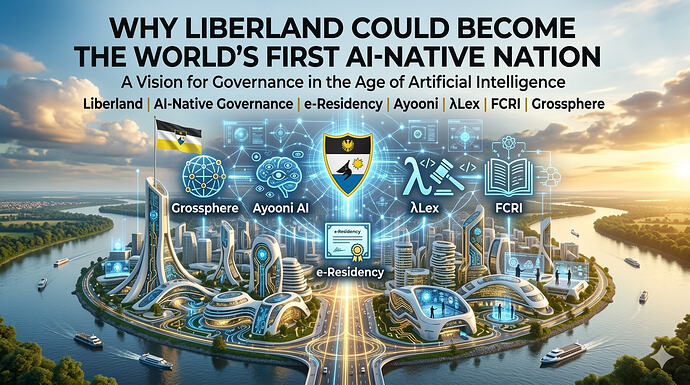
How an AI-Assisted Governance Framework Could Support the World’s First AI-Native Nation

0

Article written by David Carmel Alex

The Liberland AI Governance Proposal

1000036400

The emergence of artificial intelligence presents an opportunity to rethink how governance systems operate.

Rather than replacing human institutions, AI can function as a support layer that improves clarity, efficiency, and transparency in governance.

The Free Republic of Liberland, due to its early institutional stage and global digital citizenship model, is uniquely positioned to become the world’s first AI-native nation — a nation where artificial intelligence responsibly assists institutional processes.

This document proposes a framework in which three systems could support such a vision:

• Ayooni — an AI governance-support system

• λLex — a computable governance language

• FCRI — an academic research and education platform focused on institutional systems

Together, these elements could form a governance support architecture designed to strengthen transparency, reduce ambiguity, and assist policymakers in decision-making.

-–

Strategic Context

Governments around the world are beginning to explore the role of artificial intelligence in governance.

However, most existing states face structural limitations:

• legacy legal frameworks

• bureaucratic complexity

• fragmented digital infrastructure

These constraints make systemic redesign extremely difficult.

Liberland, by contrast, is still in an institution-building phase, creating a rare opportunity to design governance systems intentionally rather than retrofit them later.

This environment makes Liberland an ideal candidate for exploring AI-assisted governance models.

-–

The Role of Digital Citizenship

Liberland’s e-Residency program already represents an innovative approach to citizenship.

Through this model, individuals around the world can participate in Liberland’s ecosystem regardless of geography.

This creates a distributed network of citizens, researchers, entrepreneurs, and technologists connected through shared values rather than physical borders.

Digital citizenship naturally aligns with the concept of AI-supported governance infrastructure, as both rely on strong digital systems and transparent institutional processes.

-–

Proposed Governance Support Architecture

1. Ayooni — Institutional AI Support Layer

Ayooni is designed as an AI orchestration system that assists institutions rather than replacing them.

Potential applications in a national governance context include:

• policy impact simulations before implementation

• institutional data analysis and decision modeling

• identification of regulatory conflicts or unintended outcomes

• automated transparency reporting

The system operates as an advisory intelligence layer, while final decision authority remains fully human.

-–

2. λLex — Computable Governance Language

One of the biggest challenges in governance is ambiguity within legal language.

λLex is a structured governance language designed to make policies and institutional rules logically interpretable and auditable.

Possible applications include:

• structured policy drafting

• governance simulation models

• automated compliance analysis

• transparent rule verification

This framework does not replace traditional legal language but adds a structured analytical layer that reduces ambiguity.

-–

3. Fusion Civilization Research Institute (FCRI)

The Fusion Civilization Research Institute is an academic institution focused on systems-level governance education and research.

Programs include:

• AI governance and regulatory systems

• digital justice and legal technology

• decentralized economic infrastructure

• crisis and risk system design

• behavioral decision systems

• systems thinking and strategic foresight

FCRI could function as a research partner supporting the long-term development of innovative governance frameworks relevant to Liberland.

-–

Potential Benefits for Liberland

If implemented carefully, an AI-assisted governance framework could offer several advantages:

Increased Transparency

Structured rule systems and AI analysis tools can improve visibility into institutional processes.

Faster Policy Evaluation

Policy simulation tools allow governments to evaluate potential consequences before implementation.

Reduced Administrative Complexity

AI-assisted systems can help manage complex regulatory environments with greater efficiency.

Global Innovation Leadership

By exploring responsible AI governance frameworks early, Liberland could position itself as a global reference point for next-generation institutional systems.

-–

Implementation Path (Conceptual)

A possible development path could involve the following stages:

Phase 1 — Research Collaboration

Exploratory discussions between Liberland institutions and FCRI research teams regarding AI-assisted governance models.

Phase 2 — Prototype Systems

Development of limited experimental tools such as:

• policy simulation engines

• structured rule frameworks

• institutional data analysis systems

Phase 3 — Pilot Programs

Testing AI-supported governance tools in specific administrative areas.

Phase 4 — Institutional Integration

If proven effective, these systems could become part of Liberland’s long-term digital governance infrastructure.

-–

Ethical and Governance Safeguards

Any AI-assisted governance system must include strict safeguards:

• AI must remain advisory rather than authoritative

• human oversight must remain mandatory

• transparency and auditability must be built into the system

• ethical governance standards must be clearly defined

These principles ensure that technology strengthens governance rather than concentrating power.

-–

Strategic Vision

Liberland already represents a bold experiment in governance.

By exploring responsible AI-assisted governance systems, it has the opportunity to become something even more remarkable:

A nation designed for the institutional realities of the 21st century.

A nation where governance is:

• transparent

• adaptive

• digitally integrated

• supported by intelligent systems

This vision does not replace democratic institutions.

It strengthens them.

-–

Closing Statement

History occasionally presents moments when new institutional models become possible.

Liberland represents such a moment.

As an e-Resident and researcher working on institutional AI systems, I believe there is an opportunity to explore ideas that could strengthen governance in the digital age.

I look forward to contributing to discussions around how Liberland can continue to innovate responsibly and thoughtfully.

David Carmel Alex

Founder — Grossphere

Founder — Fusion Civilization Research Institute (FCRI)

Architect — Ayooni AI System

Liberland e-Resident

Was WW3 Predicted by Pike or Carr? How Liberland Offers a Neutral Path Forward

0

Was WW3 Predicted by Pike or Carr? How Liberland Offers a Neutral Path Forward 🌍 The geopolitical climate of 2026 feels like a mirror reflecting a dark, 150-year-old vision. Whether you believe the “Three World Wars” blueprint was a 19th-century letter from Albert Pike or a 1950s warning from William Guy Carr, the functional reality is unfolding with chilling precision. The “Script” of Three World Wars: The Pike-Carr narrative described a calculated path to global exhaustion: * WW1: To overthrow the Czars and transform Russia into a Communist stronghold. * WW2: To destroy Nazism and establish a sovereign state for Zionism. * WW3: A final conflict triggered between “Political Zionists and the leaders of the Islamic World,” designed to drag the entire globe into a state of physical and moral collapse. As the world is pressured to pick a side in this final “social cataclysm,” the Free Republic of Liberland is offering a third option: Total Neutrality. The Architecture of a Safe Haven: Unlike traditional states bound by military “tripwires,” Liberland’s survival strategy is built on: ✅ Non-Aggression: A constitutional commitment to non-intervention. ✅ Decentralized Resilience: Blockchain-based governance that keeps the economy and identity secure, regardless of global instability. ✅ Diplomatic Sovereignty: A “Switzerland 2.0” model on the Danube. A Vision for Universal Peace 🕊️ We are honored to announce that His Eminence Shyalpa Tenzin Rinpoche will keynote Liberland’s 11th Anniversary. Rinpoche is the visionary behind the Universal Peace Sanctuary in Lumbini, Nepal—the birthplace of the Buddha. By envisioning Liberland as the future custodian of this sanctuary, Rinpoche is bridging ancient wisdom with modern liberty. As he notes: “We must lead by example, and I am confident that is exactly what Liberland is currently doing now.” In a time of chaos, Liberland isn’t just surviving the script—we are flipping it. #Liberland #Geopolitics #UniversalPeace #Neutrality #Blockchain #Lumbini #WW3 #FutureOfGovernance

Living Fully: Finding Joy In Every Breath

0

This summary comes directly from the author Liberland’s very own Ambassador for Peace, Shyalpa Rinpoche

Unlock the chains of Self-Cherishing;

When our motivation is pure, we can accomplish everything easily, like an eagle soaring effortlessly on the wind. When we lack the noble aspirations of a compassionate heart, we will not achieve anything worthwhile in our spiritual practice, even if we sit in meditation day and night for over a hundred years. What matters most is not what we do, but how we do it.

Put a drop of poison in a glass of milk and you would not drink it. If you are motivated purely by selfish aims, the results could be just as deadly. On the other hand, if you are sincerely in-terested in relieving the suffering and pain of others, your life will flourish.

A miserly person who hoards wealth and cares nothing for others feels lonely and unloved. If we focus too much on our own desires and interests, we limit our chances for happiness. Caring about others is the way to hone our emotional intelligence. If we start with the noble aspiration to be helpful to all of humanity, our lives will be blessed with joy and graced with purpose. We begin with the sublime intention to achieve enlightenment for the benefit of all. As we say in our tradition, sublime in the beginning, sublime in the practice, and sublime at the conclusion.

A genuine spiritual path loosens the chains of self-cherishing, the tightness in our hearts that narrows our vision and limits our horizons. True compassion illuminates our lives and helps us to guide others, just as a lighthouse signals a safe path for ships lost at sea. Always appraise your intentions by asking yourself, “Is this kindhearted? Or is this meaningful?” Make this your natural way of being. Unlock the chains of Self-Cherishing;

When our motivation is pure, we can accomplish everything easily, like an eagle soaring effortlessly on the wind. When we lack the noble aspirations of a compassionate heart, we will not achieve anything worthwhile in our spiritual practice, even if we sit in meditation day and night for over a hundred years. What matters most is not what we do, but how we do it.

Put a drop of poison in a glass of milk and you would not drink it. If you are motivated purely by selfish aims, the results could be just as deadly. On the other hand, if you are sincerely in-terested in relieving the suffering and pain of others, your life will flourish.

A miserly person who hoards wealth and cares nothing for others feels lonely and unloved. If we focus too much on our own desires and interests, we limit our chances for happiness. Caring about others is the way to hone our emotional intelligence. If we start with the noble aspiration to be helpful to all of humanity, our lives will be blessed with joy and graced with purpose. We begin with the sublime intention to achieve enlightenment for the benefit of all. As we say in our tradition, sublime in the beginning, sublime in the practice, and sublime at the conclusion.

A genuine spiritual path loosens the chains of self-cherishing, the tightness in our hearts that narrows our vision and limits our horizons. True compassion illuminates our lives and helps us to guide others, just as a lighthouse signals a safe path for ships lost at sea. Always appraise your intentions by asking yourself, “Is this kindhearted? Or is this meaningful?” Make this your natural way of being.

A Vision for Universal Peace: Rinpoche to Keynote Liberland’s 11th Anniversary From the Blessed Birthplace of the Buddha to the Future of Liberty

0

A central pillar of His Eminence Shyalpa Tenzin Rinpoche’s mission is the Universal Peace Sanctuary, currently under construction in Lumbini, Nepal—the sacred UNESCO World Heritage site recognized as the birthplace of Gautama Buddha.
By rooting his pure vision in Lumbini, Rinpoche connects the ancient wisdom of the Buddha with the modern aspirations of Liberland. Just as the Buddha taught that peace begins with the individual, Rinpoche’s sanctuary serves as a “Peace Engine” for the worl
Why Lumbini Matters to Liberland:

  • A Sacred Foundation: Lumbini is the historical ground where the philosophy of non-violence and compassion was born. Rinpoche believes this dynamic energy is essential for a new nation like Liberland.
  • The Custodianship: In a groundbreaking move, Rinpoche envisions Liberland as the future custodian of the Universal Peace Sanctuary, ensuring that the legacy of Lumbini’s universal peace is protected by a state dedicated to sincere voluntary cooperation.
  • Leading by Example: By linking the birthplace of the Buddha to the birth of a new microstate, Rinpoche aims to show that “Universal Peace” is not just an ancient ideal, but a practical blueprint for future societies on Earth and beyond.

“We must lead by example, and I am confident that is exactly what Liberland is currently doing now.” — Shyalpa Tenzin Rinpoche

Shyalpa Monastery’s Marpa School Welcomes 30 New Children

0

Liberland’s Ambassador for Peace Shyalpa Rinpoche oversees Shyalpa monastery and nunnery and we will be including more coverage from Nepal in the future.

Yesterday we welcomed 30 young boys and girls to study in the Marpa school which is under the umbrella of Shyalpa monastery and nunnery in Nepal. His Holiness Kyabgon Jedrungpa kindly offered refuge vows to them for their journey on the spiritual path. These children are now very fortunate as we offer them modern education as well as spiritual training for free. We also provide three meals per day and afternoon tea, living quarters in the hostel, blankets, sheets, pillows, towels, socks, sandals, toothpaste, toothbrush, soaps, books, pens, robes & medical treatments. Shyalpa monastery and nunnery is their home for the rest of their lives if they personally choose to live here continuously. It is indeed a great honor to serve these most underprivileged children who have very little resources in their village to prepare themselves to face the ground reality and survive in this tough world. If you are with compassion and interested to know more to share your resources to children who are in real need, please kindly contact me 🙏